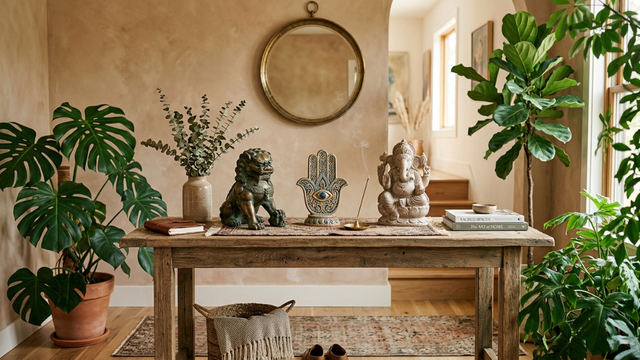
There's a long, cross-cultural history of placing protective figures within homes — objects believed, symbolically or literally, to guard a space and its occupants. This kind of protective symbolism continues to resonate in modern interiors, even among people who don't hold strictly traditional beliefs.
Psychologically, surrounding oneself with symbols of protection and stability can have a genuine grounding effect, regardless of literal belief in their power. A meaningful object near an entryway, for instance, can serve as a daily reminder of safety and intention each time someone enters or leaves a space. This effect is similar to other forms of intentional object placement studied in environmental psychology, where meaningful cues in a space can subtly influence mood and behavior.
Different cultures have developed distinct protective figures — guardian lions, serpent deities, protective spirits — each carrying specific stories and symbolic meanings tied to their region of origin. Choosing a figure with genuine cultural background, rather than a generic decorative object, often adds depth that purely aesthetic décor lacks. Learning the specific story behind a chosen figure also gives homeowners something meaningful to share with guests, turning a décor choice into a small cultural conversation.
Material and craftsmanship matter significantly in this category. A well-carved, detailed figure tends to carry more visual and symbolic weight than a mass-produced equivalent, which is part of why many people seek out specialty retailers rather than general home goods stores for these specific pieces. Fine detail in the carving — scales, facial expression, posture — often distinguishes a piece that feels genuinely significant from one that feels purely ornamental.
Placement near thresholds — front doors, room entrances, or even desks — tends to align most closely with the traditional protective function these figures historically served. Some households also place smaller protective figures near children's rooms or home offices, extending the same guardianship concept to spaces considered particularly important to protect.
For those interested in this category of décor, ShaolinMart offers a curated selection specifically focused on pieces with documented cultural and symbolic significance.
Combining multiple protective figures within a single home is common in many traditions, with different guardians sometimes assigned to different rooms or functions based on their specific symbolic associations. A figure associated with water-based protection might be placed near an entryway, for instance, while one associated with stability or grounding might suit a study or office space. This layered approach allows households to draw on a broader range of symbolic protection rather than relying on a single object to represent the entire home's sense of security, reflecting a more nuanced, room-specific approach to spiritual décor.
FAQ
Do protective statues need to be placed at the front door specifically? Not necessarily, though entryways and thresholds are traditionally the most common placement.
Is protective symbolism purely superstitious? Interpretation varies; many people value these objects for their psychological grounding effect regardless of literal belief.
What materials are most common for protective statues? Stone, resin, and metal are all common, with detailed craftsmanship generally considered more meaningful than mass-produced versions.
Can protective figures be placed in rooms other than entryways? Yes, some households place smaller versions near children's rooms or home offices to extend the same symbolic protection.
Can a home have more than one type of protective figure? Yes, many households use different guardian figures for different rooms, matching each figure's specific symbolism to that space's function.
Comments