Cameroon e-visa for the United Kingdom
Are you planning an excursion to the heart of Africa, visiting marketplaces in Douala, experiencing the lively culture of Yaoundé, or exploring the magnificent rainforests of the south? Before you pack your bags, there is one important logistical aspect you must completely understand: the Cameroon e-visa for the United Kingdom citizens planning to visit this intriguing country. Consider this your travel companion guide, from selecting the appropriate visa type to safety tips, network recommendations, and what you should do before arriving in Cameroon.
How long does the Cameroon E visa take?
Processing times vary based on your need for a Cameroon urgent visa, but here is a breakdown that most applicants experience:
- 9 to 11 working days for Normal processing
- 7 to 9 working days for Rush processing
- 5 to 7 working days for Super rush processing
These timelines refer to when you receive the electronic authorization. Upon arrival in Cameroon, typically complete biometric steps and issue a visa sticker in your passport.
How long can you stay in Cameroon?
Once your Cameroon e-visa is approved and issued, your allowed stay depends on the type you chose:
- 0 to 6 months (Cameroon Short-stay Visa) with Single and Multiple entries
- 6 months to 1 year (Cameroon Long-stay Visa) with Single and Multiple entries
- 1 to 4 days (Cameroon transit visa) with single and Multiple entries
- Over 4 days (Cameroon Express Visa) with single and Multiple entries
Be sure to plan your travel dates within these frames to avoid visa expiration issues.
How do I apply for a Cameroon eVisa online?
The United Kingdom traveller applying for your Cameroon e-visa can be straightforward if you follow these steps:
- Upload Required Documents – Make sure everything matches exactly.
- Fill the application form: Enter the personal information and travel document related to the visa application form.
- Submit and Wait for Approval—Review processing timelines that match your travel dates.
- Receive Your Confirmation – You’ll get an authorization document (often with a QR code) to present upon arrival.
While a few details may vary depending on your circumstances, this is the general flow most travelers follow.
What documents do I need to travel to Cameroon?
One of the most effective strategies to avoid delays is to prepare your papers ahead of time. You'll normally need:
- A valid passport (with at least six months left)
- Proof of return or onward travel (an air ticket)
- Proof of accommodations (hotel reservation or invitation)
- International Vaccination Certificates
- Provide evidence of your visit's purpose.
- Certificate of residence or address proof
Some countries may demand additional items, but having them prepared will put you ahead of the game. Missing or mismatched documents are one of the most common reasons for application delays or denials.
What is better, eVisa or visa on arrival?
To decide what is better, an eVisa or Visa on Arrival, it is important to first understand how an eVisa works.
- An eVisa (Electronic Visa) is a visa you apply for online before you travel. You fill out an application form and upload the required documents. Once approved, you receive your visa electronically — usually by email — which you must print and present at the border.
- Visa on Arrival means you get your visa when you land at the destination country’s airport or border crossing. You don’t apply online in advance; instead, you complete the paperwork and pay the visa fee upon arrival.
Which payment method is available in Cameroon?
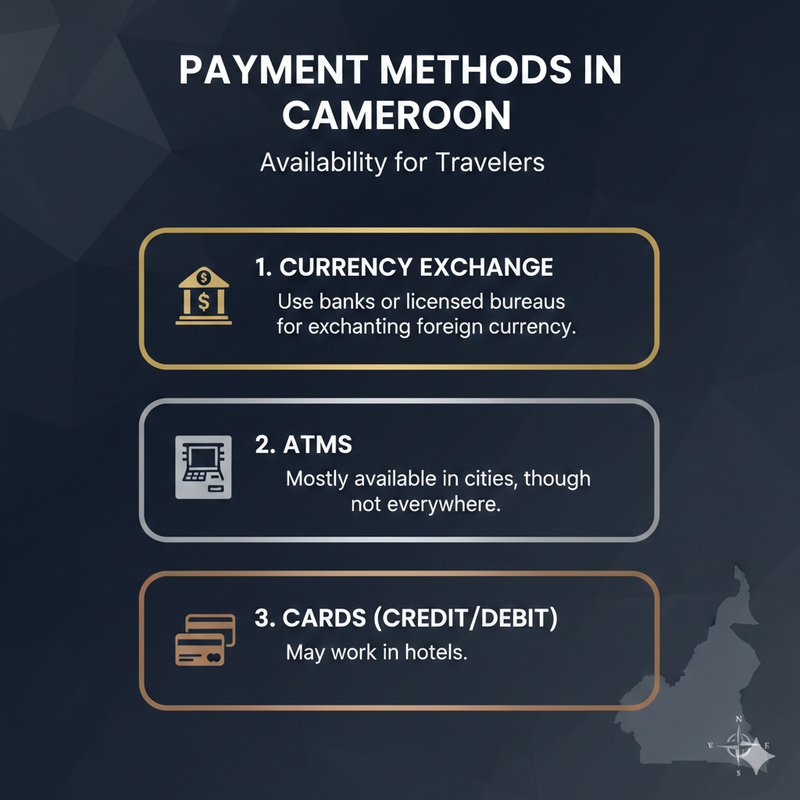
Being prepared for how to manage money while traveling is crucial. The local currency in Cameroon is the Central African CFA Franc (XAF) — you’ll likely use it for most purchases.
- Use banks or licensed bureaus for exchanging foreign currency; they’re safer and often offer reasonable rates than changing abroad.
- ATMs are mostly available in cities, though not everywhere — always have some local francs handy before venturing into rural areas.
- Credit and debit cards may work in hotels and larger stores but aren’t widely accepted elsewhere.
What is the best option to exchange currency?
For better value and convenience:
- Change money at major banks such as Société Générale, Ecobank, or Afriland First Bank.
- Licensed foreign exchange houses in Yaoundé and Douala often offer good rates.
- Avoid street exchangers — it’s not worth the risk of counterfeit bills or scams.
Which network is best in Cameroon?
Staying connected is essential. Here are some of the top mobile network providers you’ll encounter:
- MTN Cameroon—Widest coverage and fast data, ideal for urban and most rural areas.
- Orange Cameroon—Strong network and affordable plans.
- Nextel—Competitive plans and decent coverage.
- Camtel—National provider with some broadband services.
Tourists often buy a local SIM upon arrival and choose prepaid plans. MTN tends to offer the best overall coverage, especially if you plan to travel beyond main cities.
Do I Need Malaria Tablets for Cameroon?
Yes — malaria risk in many regions of Cameroon is considered high, and travelers are encouraged to take prophylactic tablets, use repellents, and apply mosquito nets during your stay.
Yellow fever vaccination is also required, and you’ll need your certificate for entry.
What is the speed limit in Cameroon?
Driving in Cameroon can be an adventure: rural roads vary widely in quality, and signage is not always clear.
- Urban areas: approximately 50 km/h.
- Rural roads: 80-90 km/h.
- Highways: approximately 100 km/h.
Always obey local traffic regulations, exercise caution at night, and drive cautiously - road safety enforcement varies greatly.
Do e-Visa agents provide better guidance than government instructions online?
Cameroon visas are now fully online, so travelers often compare government e-Visa instructions with agent guidance—let’s look at both briefly.
Government e-Visa Instructions
What the Cameroonian government says:
- Confusing interface—navigation and instructions can be tricky.
- No personalized help—it doesn’t answer individual questions.
- Slow support—email responses and issue resolution can take time.
What eVisa Agents Like cameroon-evisa.org Do
A site like cameroon-evisa.org positions itself as a visa assistance service. According to its own content, it offers:
- Simplified application support
- 24/7 assistance
- Help with filling forms and submitting documents
- Communication support and guidance
Is Cameroon Safe to Travel To?
Cameroon is a varied country with welcoming people, vibrant cultures, and breathtaking landscapes—but it's crucial to travel safely.
- Some border regions and isolated areas have travel advisories, so check the latest information before planning your journey.
- Petty theft is frequent in cities, so keep your possessions safe and be cautious.
- Use reliable taxis or booked transportation, particularly after dark.

Conclusion: Your Trip Starts With Preparation
With proper planning and information, obtaining an e-visa for Cameroon from the United Kingdom may be an exciting aspect of your trip adventure. From selecting the appropriate visa type and comprehending dates to preparing paperwork and knowing what to anticipate upon arrival, this guide will prepare you to go on your Africa trip with confidence.
Remember to apply early, compile your papers completely, and plan your trip arrangements - and you'll be ready to discover Cameroon's dynamic cities, rich cultures, and stunning natural beauty!
FAQs – Your Quick Questions Answered
- How long before my flight should I apply for a Cameroon e-visa?
Apply at least 2-3 weeks before your trip to provide time for processing and document verification.
- Can I extend my stay in Cameroon?
Extensions may be available in some cases, but it is advisable to check with local authorities first.
- Do UK passport holders require a yellow fever vaccination?
Yes, a certificate is necessary to enter owing to health rules.
- Can I use international credit cards in Cameroon?
Cards may work at large hotels and stores, but you will primarily rely on local currency.
- Is public transportation in Cameroon safe?
To ensure safety and comfort, consider using reputable or hotel-recommended public transportation, which varies by location.
Comments