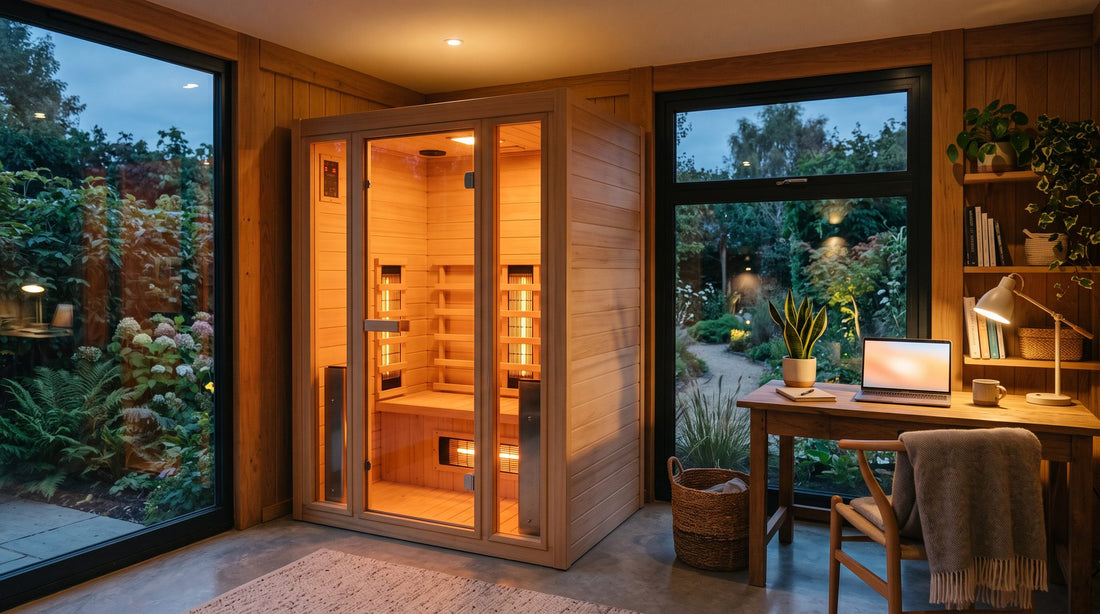
The controls and the panels are where a sauna stops being a box of timber and becomes a piece of equipment. Temperature settings decide whether a session is comfortable or unbearable, and the panels decide whether the heat is even or concentrated in one corner. Together they account for more of the experience than any other part of the cabin, and they are worth understanding before you buy.
Most domestic cabins are simpler than the specification pages suggest. A control with a range of temperatures, a timer and a session length does almost everything an owner needs, and a cabin with well-placed panels delivers an even warmth without any of the elaborate features that make a control panel expensive. Simple, done properly, beats complicated every time.
This guide explains how temperature controls and heating panels work together, what to look for in both, and how to set a comfortable routine around them. Health Mate UK has been manufacturing infrared saunas since 1979 and has developed its patented Tecoloy heating elements for consistent, controllable warmth in domestic homes.
Temperature Controls in the Best Infrared Sauna UK Cabin
Start with the range. A useful control offers a broad spread of temperatures rather than a narrow one, because the right setting depends on the person, the season and the length of the session. A model that offers only a hot and a warm setting will be run at one of the two, and the control becomes a formality rather than a tool.
Then look at the increments and the response. A control that adjusts in small steps gives a genuine choice, while one that jumps between presets leaves you choosing between too cool and too hot. The Best Infrared Sauna UK option is usually the one with a straightforward dial or a simple display that you can adjust without reading a manual, since a control you find annoying is one you avoid using.
A timer is the feature that most changes the character of a sauna. Starting the cabin while you are finishing a meal or dealing with the end of the day removes the waiting, and the session becomes something you step into rather than something you plan around. Look for a timer measured in minutes rather than hours, so that the warm-up matches the gap in your evening.
Session length settings and a start time function are related conveniences, and together they allow the cabin to be ready for a specific moment. Owners who set the cabin to finish warming at a particular time report that they use it more often than those who switch it on and wait, simply because the effort involved is smaller, and that is what a Best Infrared Sauna UK cabin should make possible.
Heating Panels, Placement and Control
How the Panels Work
Infrared panels emit energy towards the body rather than heating the air, so their placement decides which parts of you are warmed first. Panels on the back wall warm the back and the shoulders, panels low down warm the legs, and a panel above the bench warms the head area. A cabin with panels distributed around the walls feels more even than one with a single bank of emitters.
The surface temperature of a panel is limited for safety, which is why good infrared cabins feel warm rather than scorching. That limit, and the way the energy is spread across the panels, is what allows a comfortable cabin temperature to be reached without the air becoming oppressive. It is the technology that makes home saunas practical.
Zoning and Control
Some cabins allow separate zones to be run, which is useful in a shared household because different people like different temperatures. Where that is not offered, a single setting with a fine adjustment is usually enough. Owners who share a cabin tend to agree on a middle setting and adjust with the door open rather than fiddling with controls.
Setting Up an IR Sauna UK Heating Routine
Give the room time to catch up. When a cabin is in a cool bathroom or a cold garden room, the first minutes are spent warming the air and the walls as well as your body, and a session that feels flat at the start often improves considerably by the middle. Opening the door briefly and letting the fresh air in also helps the room breathe.
Learn how your cabin settles and stabilises. Many owners find that a setting which feels too hot for the first few minutes becomes just right by the middle of a session, and that the reverse is also true on a warm day. Nothing is wrong with the equipment; it is simply how a heated box in a real room behaves.
The control is also a safety device, and it is worth knowing what it does. An over-temperature cut-out, a surface limiter and a control that returns to the off position protect both the cabin and the people using it. An IR Sauna UK cabin with those protections fitted is a machine you can leave running while you get on with the evening.
Setting Up, Caring For and Troubleshooting
Installation and Power
Controls and panels work best when the supply matches the load. Have an electrician confirm the requirement before the cabin is delivered, and check that the control panel is within reach of the bench and of a light. A control you cannot see in the dim interior of a hot cabin is a control you cannot adjust comfortably.
Care and Cleaning
Keep the panels free of dust and keep the grille clear, because a blocked emitter is both inefficient and less comfortable. A soft dry cloth is enough, and a damp cloth with a mild cleaner once a month keeps the surface in good condition. Never spray a cleaner directly onto a panel, since the moisture can reach the electronics behind it.
When Something Seems Wrong
If a cabin heats slowly, check the vents and the seals before anything else, since both are far more common causes than a fault in the heater. If one area feels much warmer than another, the panel layout is doing what it was designed to do, and running the cabin a little longer usually evens the sensation out.
Cost, Care and Sensible Expectations
What the Technology Costs
The elements and the control panel account for a substantial part of a sauna's price, and they are the parts that do the work. Good emitters with a long warranty and a reliable control are worth paying for, because they are what determine whether the cabin feels right every time or merely on the day it was delivered.
Running costs are linked directly to the settings you choose, so a sensible control has an effect on the electricity bill as well as on comfort. A well-insulated cabin reaching temperature quickly and holding it at a moderate setting uses less power than one asked to run hot, and the difference is worth understanding before you set your routine.
Health and Sensible Use
Speak to a doctor before regular use if you are pregnant, taking medication or managing a health condition, and begin with short, moderate sessions. The controls exist to make a comfortable session easy, and using them properly is a better answer than pushing through a setting that feels too hot.
Where to Buy Infra Red Sauna UK With Well-Specified Controls
Ask to operate the control yourself rather than watching a demonstration. Turn the dial, start the timer and set a session length, because a control you have already used behaves differently from one described in a brochure. Ask also what happens if the cabin overheats, and listen to how comfortably the answer is given.
Ask about the panel layout rather than the panel count. Where the emitters are placed around the back wall, the walls and the bench determines how evenly the warmth is distributed, and an answer that describes the layout in detail is a supplier who understands the product they are selling.
Above all, choose controls you find simple. The best Infra Red Sauna UK equipment is the equipment you never have to think about, and a panel with a clear display, sensible increments and a reliable timer will be used every evening while a complicated one will be worked around.
Frequently Asked Questions
What temperature should a sauna session be?
Most people settle between 40 and 60 degrees Celsius in an infrared cabin, where the air stays milder than in a steam sauna. Start lower, hold the setting for a while and adjust from there, since the sensation builds through the session rather than arriving at once.
What is the difference between infrared and traditional heaters?
Infrared panels emit energy towards the body, warming it directly while the air stays relatively cool. Traditional heaters heat the air and the stones instead, which produces a hotter, more humid room at a higher cabin temperature and a very different feeling.
Do I need a timer on an infrared sauna?
It is one of the most useful features available. A timer lets the cabin warm while you are busy elsewhere, which removes the waiting and makes a session far easier to fit into an ordinary evening rather than a planned event.
How should the heating panels be positioned?
Distributed panels around the back wall, the side walls and beneath or behind the bench give the most even warmth. A cabin with a single bank of emitters will still work, but the sensation is more concentrated and takes slightly longer to settle.
Can I clean the heating panels?
Yes, gently. A soft dry cloth for routine dust and a barely damp cloth with mild cleaner at intervals is sufficient. Never spray cleaner directly onto a panel, because the moisture can reach the electronics behind it and cause a fault.
Is it safe to leave a sauna heating?
A cabin with an over-temperature cut-out, a surface temperature limiter and a control that returns to the off position is designed to be safe to run. Those protections are the reason a certified sauna can be started and left to warm without supervision.
Conclusion
Temperature controls and heating panels are the part of a sauna that determines whether a session is pleasant, and they deserve more attention during a purchase than the timber usually gets. A broad temperature range, a timer measured in minutes and panels distributed around the cabin will carry a home sauna for a decade of everyday use.
The lesson from owning one is that simplicity wins. Owners do not programme elaborate settings or chase perfect temperatures; they set a level that feels right, adjust it once or twice and let the equipment do the rest. The best controls are the ones that require no attention at all, and the best panels are the ones that make no one think about heating.
Health Mate UK has been manufacturing infrared saunas since 1979 and has developed its patented Tecoloy elements to deliver even, controllable warmth in domestic homes, so the guidance here reflects equipment that has run for thousands of sessions rather than a laboratory sample. Comfort in a sauna is decided by the settings and the layout, and both are settled on the day you buy. Choose a wide temperature range, a timer in minutes and panels spread around the cabin, and every session becomes warm, even and predictable without any adjustment at all. Get those three right and the controls stay out of the way, and every session is warm, even and exactly as comfortable as you set it.
Comments